Potentially immediate danger?
A tree has failed, moved, split or become unstable. Emergency assessment comes first.
Dangerous, failed or storm-damaged tree?
We attend tree emergencies across the Northern Beaches to assess the immediate hazard, stabilise the area and undertake emergency tree work where required.
Our AQF Level 5 Consulting Arborists document the tree, defects, damage and site conditions with photographs and prepare the appropriate evidence or report for Council requirements.
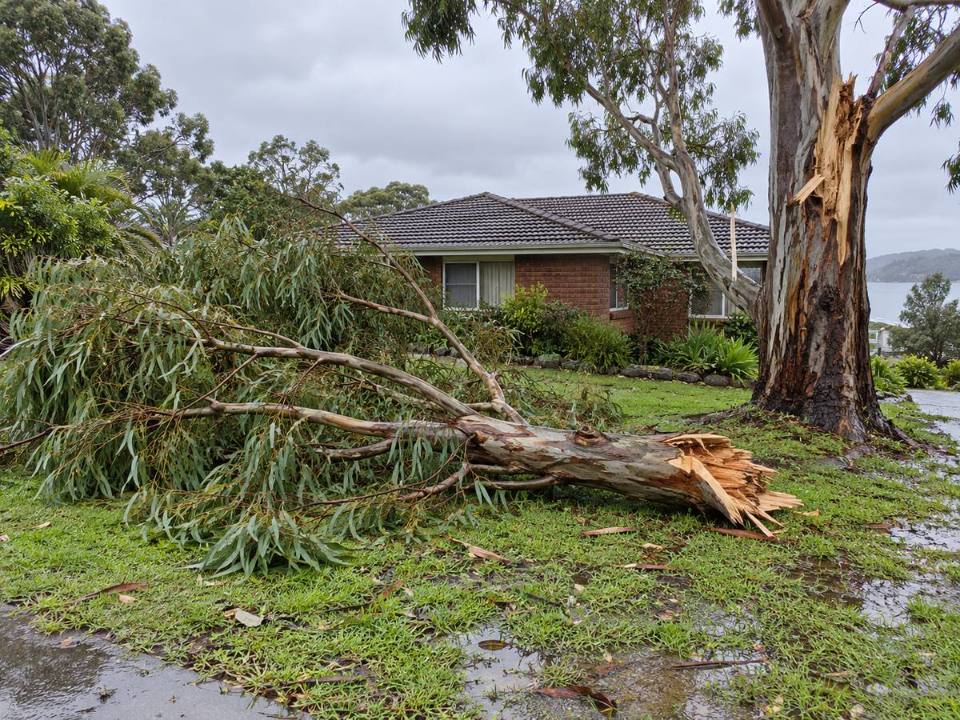
If anyone is trapped or injured
If anyone is trapped or injured, call 000. For storm assistance, for example a fallen tree blocking access or a tree that may fall on your property, call NSW SES on 132 500.
Keep people away from the tree and anywhere it could fall or drop branches. Stay well clear of fallen powerlines and never go beneath a damaged or unstable tree to take photographs. See NSW SES contact details.
A genuine tree emergency is different from an ordinary request to remove a tree. When a tree or major branch has failed, partially failed, become unstable or presents an immediate hazard, our first priority is the safety of people and property.
We assess the immediate situation and undertake the tree work necessary to stabilise and make the area safe where appropriate. Before and during the work, we photograph and document the tree, failure, defects and surrounding site conditions. Where Council documentation is required, an AQF Level 5 Consulting Arborist prepares the appropriate report or written evidence for Council records.
This provides a documented record of what happened, what condition the tree was in, why emergency work was necessary and what work was undertaken.
Potentially, but Northern Beaches Council's requirements are specific. Council currently lists as permit-exempt a tree considered high risk or imminent danger where it is certified by an AQF Level 5 qualified arborist. The owner can remove it without Council consent after obtaining written confirmation from the arborist stating:
This exemption applies to trees meeting Council's specific imminent-danger and high-risk criteria. It is not a shortcut around an ordinary Tree Removal Application. See Council's rules for removing trees on private land.
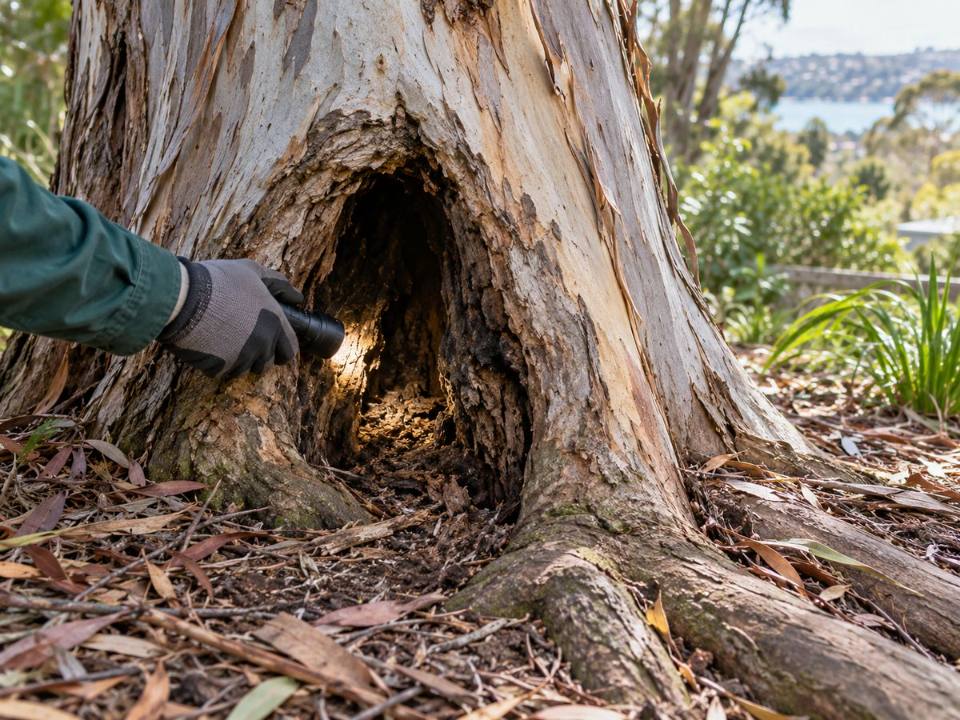
There are situations where the immediate priority is controlling an existing hazard. A tree or major limb may already have failed, be partially fallen, be obstructing safe access or have become unstable following a storm or structural failure. In these circumstances, our approach is:
For Council requirements and record keeping.
The documentation is important. Once a failed or unstable part of a tree has been removed, some of the physical evidence may no longer be visible in its original position. Photographs and site observations can record the condition encountered when we arrived, the defects or failure involved and the emergency work undertaken.
This section is our arboricultural advice, not Council's definition.
The arborist considers the tree, the defect, the likelihood of failure, what could be struck and the potential consequences. Calling a tree an emergency does not make it one. The evidence must support the conclusion.
A large, leaning, old or cavity-bearing tree is not automatically an imminent danger. Neither is a tree simply because it grows close to a house. These observations can justify professional assessment, but they do not by themselves establish that immediate removal is necessary.
Decay also needs to be assessed in context. Trees can compartmentalise injured and infected wood, while a full green canopy does not necessarily establish that a tree is structurally sound. The important question is: what does this defect mean for this particular tree, in this particular location?
A tree has failed, moved, split or become unstable. Emergency assessment comes first.
The tree has defects or has changed, but nothing has failed. A health and safety assessment is the right starting point.
If there is no emergency, removal follows the normal Council pathway, which we check first.
Council separately lists trees that have fallen or partially fallen in a storm and still present a danger as permit-exempt, with photographs required. This is not identical to the Level 5 imminent-danger pathway. Where it is safe to do so, photographic evidence of the tree and surrounding area should be preserved. Never put yourself beneath or close to an unstable tree merely to obtain photographs.
Council lists a dead tree not required as habitat for native animals as permit-exempt and recommends photographic evidence. If it is unclear whether the tree is dead, whether habitat is present or whether the tree presents an immediate risk, professional assessment may be appropriate.
The assessment concerns the actual tree and actual risk, not simply whether someone wants it removed.
Species, dimensions, health and vitality.
Cracks, splits, cavities, decay, fungal fruiting bodies and major branch structure.
Root and basal condition, particularly evidence of root-plate movement.
Previous failures, storm damage and recent changes in condition.
People, buildings, vehicles and other potential targets, together with the likelihood and consequences of failure.
Sometimes the evidence supports immediate tree work or removal. Sometimes it supports further investigation, pruning, monitoring or another management response.
For ordinary significant-tree removal applications, Northern Beaches Council refers to a qualified arborist report. The imminent-danger exemption is different: Council expressly requires written confirmation from an AQF Level 5 Arborist or equivalent. Our AQF Level 5 Consulting Arborists also hold QTRA and TRAQ qualifications and have more than 32 years of arboricultural experience.
Tell us what has happened, where the tree is and whether anything has failed, moved or been damaged. Where it is safe, photographs can help us understand the situation before attending. Do not put yourself at risk to obtain photographs.
We attend the site and assess the tree, failed sections, surrounding property and immediate risks to people, buildings, vehicles and access. The first question is what needs to happen to make the situation safe.
Where emergency tree work is necessary, the immediate priority is controlling the hazard. Depending on the circumstances, this may involve stabilising the tree, removing failed or unstable sections or, where justified under the applicable pathway, removing the tree.
We photograph and document the tree, defects, failures, site conditions and emergency work. This creates a record of the condition encountered and the arboricultural reasons for the work undertaken.
Where Council documentation is required, our AQF Level 5 Consulting Arborist prepares the appropriate written report or evidence, supported by photographs, for Council requirements and record keeping.
The ability to respond to a genuine emergency should not be confused with removing a tree simply because removal is preferred. If a standing tree has not failed and there is time to assess it safely, our recommendation is based on its condition, defects and actual risk.
If the evidence does not support an emergency pathway, the appropriate next step may be a normal Tree Removal Report and Council application, pruning, further investigation, monitoring or retention. This distinction protects both the property owner and the integrity of the arboricultural assessment.
The imminent-danger exemption is not a substitute for the Development Application tree-assessment process. If you are building, extending, excavating or installing a pool or driveway around trees, the Development Application pathway may apply.
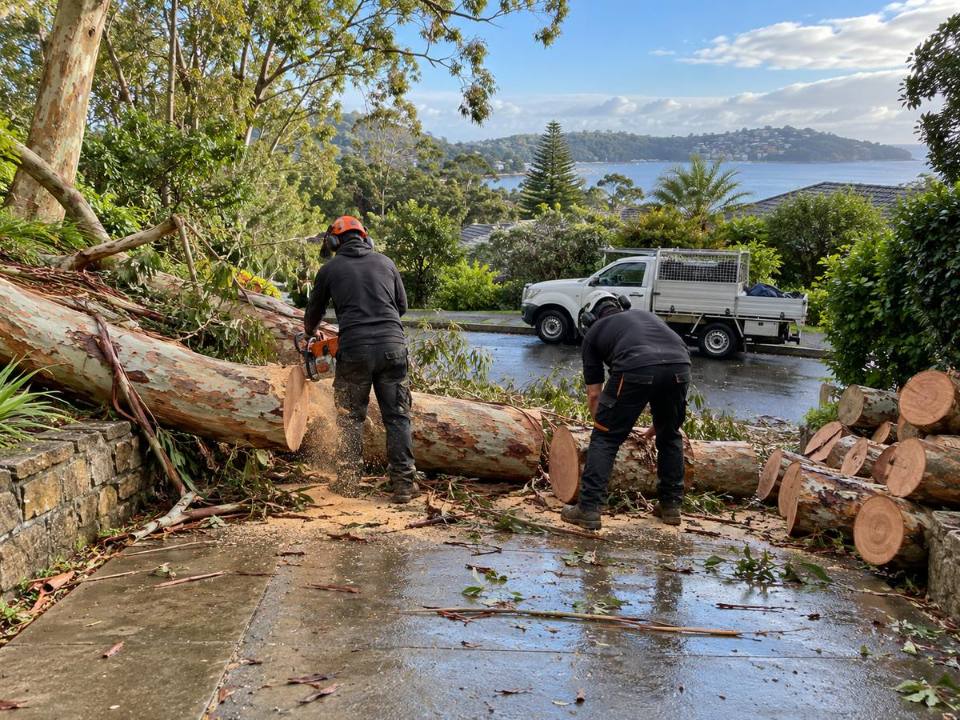
We attend tree emergencies and provide Level 5 assessments throughout the Northern Beaches Council area. See all five Northern Beaches wards.
Google reviews for Arbor Express, the consulting arborist team behind Northern Beaches Tree Permit Services.
“Robert and Arbor Express were very helpful and professional in helping me deal with identifying a large dangerous tree which needed to be removed. I highly recommend Arbor Express.”
“Alex and his team helped me finalise my DA by doing root mapping and an arborist report. Alex exemplifies quality, and I loved his work so much I will have him as my project arborist for my build.”
“Robert was easy to deal with, arrived at the appointed time and provided a completed report within days of the initial inspection. Excellent service.”
Yes. We attend the site to assess the immediate hazard and undertake emergency tree work where required. We document the condition and work with photographs and prepare Level 5 documentation where required for Council.
Council has a specific exemption where a tree is certified by an AQF Level 5 arborist or equivalent as an imminent danger and high risk to life and property. The required written confirmation must be obtained and a copy sent to Council.
The immediate priority is safety. Depending on the circumstances, we can assess the site, stabilise the hazard, undertake necessary emergency tree work and preserve photographic and arboricultural evidence for the appropriate Council requirements.
No. A lean by itself does not establish that a tree is an imminent danger.
Council separately lists a tree that has fallen or partially fallen in a storm and still presents a danger as a permit exemption, with photographs required.
The tree may need to follow the normal permit, assessment or management pathway.
Where Council documentation is required, yes. We document the tree and site, retain photographic evidence and prepare the appropriate Level 5 report or written evidence for Council requirements.
The cost depends on the tree, the site, the emergency work required and any reporting or documentation needed. We provide a written quote for the work where circumstances allow.
Council requirements can change. Confirm current requirements with Northern Beaches Council before undertaking tree work.
Where there is no emergency, removal follows the normal Council pathway.
Concerned about a tree that has not failed? Start with a Level 5 assessment.
Exemptions, other controls, Council approval and what happens after approval.
If a tree has failed, moved, split or become unstable, keep people clear of the area. Contact us with the property address and a brief description of what has happened. Send photographs only where they can be taken safely.