Is My Tree Dangerous?
Compare 15 real tree warning signs with what you can see on your own tree.
Concerned about the safety of a tree?
A crack, cavity, fungus, dead branch or leaning trunk does not automatically mean a tree is dangerous. Equally, a green, healthy-looking canopy does not necessarily mean the tree is structurally sound.
Northern Beaches Tree Permit Services provides AQF Level 5 Health & Safety Tree Assessments. We assess what the tree is actually doing, what risk it presents and whether anything needs to be done. Concern doesn't automatically mean removal. Assessment establishes the appropriate response.
Quick answer
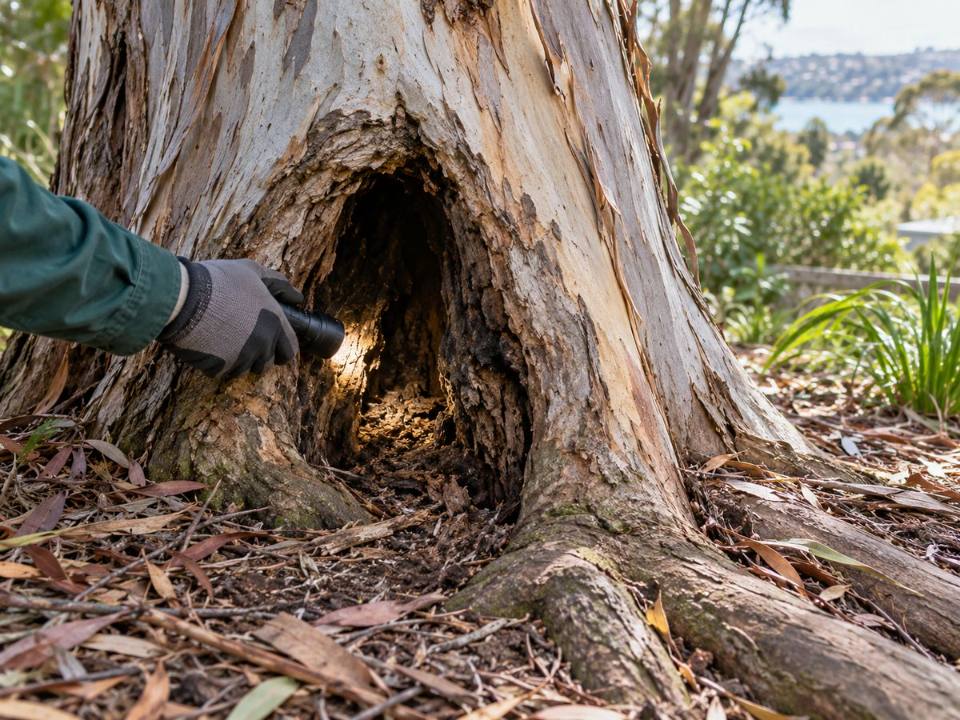
Not automatically. The significance of a defect depends on where it is, how extensive it is, how the tree has responded, the remaining sound structure, the forces acting on the tree and what could be affected if failure occurred. An arborist assesses the whole tree to establish what the defect actually means.
If there is an immediate threat to life or property, see emergency tree removal. If you have a concern but no obvious immediate danger, a Health & Safety Tree Assessment is the right starting point.
Arrange an arborist assessment if you are concerned about changes to a tree or have noticed something that does not look right:
These are reasons to investigate, not automatic reasons to remove. Recent change matters. New cracking, sudden leaning, fresh root-plate movement, recent branch failure or a noticeable change in canopy condition can be more significant than a feature that has remained stable for many years.
We assess the whole tree, not simply the defect you can see. Our arborists are QTRA and TRAQ qualified, supporting a structured assessment of likelihood, targets and consequences rather than a subjective “looks dangerous” opinion.
Canopy condition, deadwood, previous failures and branch attachment.
Cracks, cavities, wounds, decay indicators and other structural features.
Visible roots, root damage, changes in soil level and evidence of recent movement.
Slope, soil, exposure, buildings, retaining walls and changes around the root zone.
What could be affected if a branch, stem or the whole tree failed, such as a house, driveway, vehicle area or frequently occupied part of the property.
A large tree growing over a house can understandably cause concern, particularly after storms or when cracks, dead branches, cavities or movement are visible. Its size or proximity to the house does not by itself establish that it is unsafe.
We assess the tree's structure, defects, root and basal condition, likelihood of failure and what could be affected if failure occurred. Where necessary, further investigation can be recommended. The objective is to establish the actual risk and the appropriate management response rather than assume that a large tree needs to be removed.
Not automatically. Trees can survive for many years with cavities, wounds and old branch failures, and two trees showing what appears to be the same defect can need very different recommendations. Trees respond biologically to injury and decay, and their form reflects how they carry load.
Research associated with Dr Alex Shigo on how trees compartmentalise decay and Professor Claus Mattheck's work on tree mechanics reinforce the same practical principle: a defect has to be interpreted in context, not simply identified.
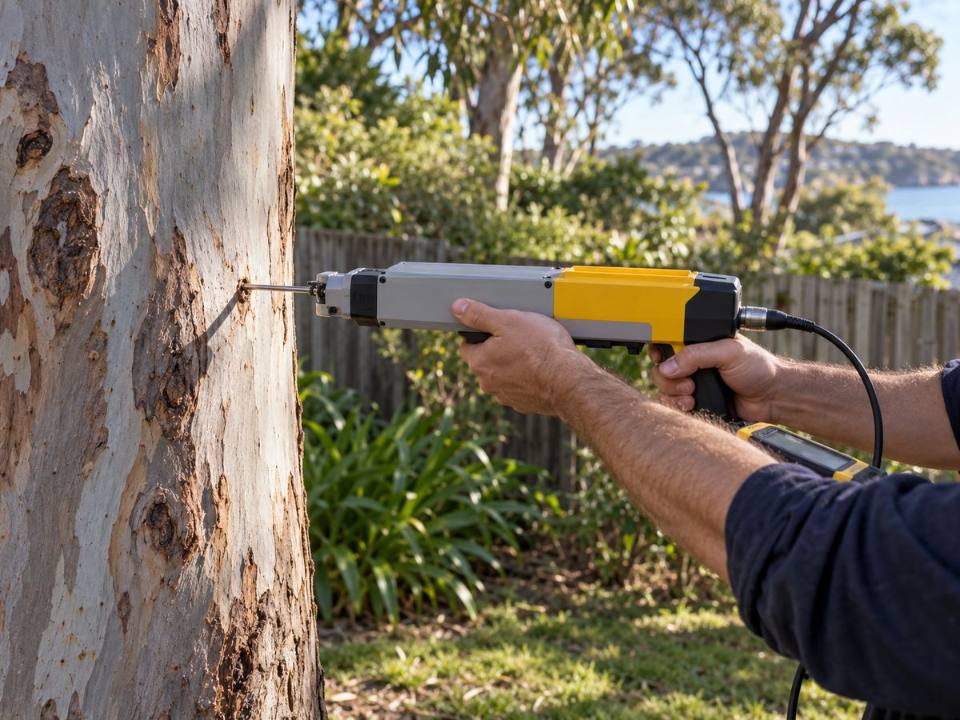
Where visual assessment identifies a defect that warrants further investigation, additional diagnostic methods may be considered. A Resistograph measures drilling resistance through the wood and can help an arborist understand the location or extent of internal deterioration. It is not automatically used on every tree.
Send photographs of the tree and explain what has changed or what is concerning you. If Council has contacted you, include the correspondence.
An AQF Level 5 Consulting Arborist inspects the tree, its surroundings and what could be affected if failure occurred.
We consider the defects present, how the tree has responded, the likelihood of failure and the potential consequences. Further investigation may be recommended where visual inspection alone does not provide enough information.
The outcome may be no immediate work, monitoring, pruning, further investigation, management of the site or target area, a Tree Removal Report, a Council tree removal application or immediate action where Council's emergency criteria are satisfied.
The assessment determines the response. Removal is not predetermined.
Depending on the assessment and the scope quoted, you may receive on-site arboricultural advice, written findings, photographs, risk considerations and management recommendations. Where the findings support a Council pathway, appropriate documentation can be prepared. Your quote will clearly identify what is included before work begins.
Most concerns are handled through a normal Health & Safety Tree Assessment. Council has a separate pathway for a tree certified by an AQF Level 5 arborist or equivalent as a high risk or imminent danger to life and property, subject to the required written evidence. That is not the same as a tree that simply looks unhealthy or contains a defect; the assessment has to support the conclusion. See Council's private-land tree page.
Removal is one possible outcome, not the predetermined one. The purpose of the assessment is not to find a reason to remove a tree. It is to establish what is occurring and recommend an appropriate response.
Where nothing needs to be done now.
Where a condition is present but does not presently justify intervention.
Where appropriate pruning can address defective or dead branches while retaining the tree.
Where additional information is needed about internal wood, roots or another structural concern.
Where changes around the tree or target area can appropriately reduce risk.
Where the findings provide arboricultural grounds to seek Council approval. See tree removal.
Where the tree satisfies Council's high-risk or imminent-danger criteria.
Once the appropriate exemption or Council approval is established, tree removal can commence.
Health & Safety Tree Assessments are relevant to more than a single home. Strata and body corporate managers, schools, commercial sites and property managers often need to understand the condition of trees over frequently occupied areas rather than decide on removal.
We assess private trees throughout the Northern Beaches Council area, across Curl Curl, Frenchs Forest, Manly, Narrabeen and Pittwater wards.
Google reviews from Northern Beaches Tree Permit Services clients and from Arbor Express, the consulting arborist team behind Northern Beaches Tree Permit Services.
“Robert provided a relaxed and very professional service. He listened to both parties disputing the removal of a tree, and his comprehensive report resolved the issues between them.”
“Rob was thorough and shared our concern for our trees, which had extensive psyllid dieback. His detailed report was accepted immediately by council, and his environmental approach was much appreciated.”
“We were concerned about some large gums dropping sap and expected to remove them. After the Northern Beaches arborist's review we were convinced the trees were healthy. A very big saving.”
A Health & Safety Tree Assessment is the starting point where you have a concern about a tree but no obvious immediate danger. Emergency Tree Removal is for a tree that may be an imminent danger and high risk to life or property, where Council's Level 5 pathway may apply.
Where justified, a Resistograph can provide additional information about internal wood condition. It is used as part of an assessment rather than as an automatic test for every tree.
Where the findings provide arboricultural grounds for removal, they can be documented for the appropriate Council pathway. A defect does not by itself guarantee approval.
Where removal is supported, the relevant Council pathway still needs to be established. Once the appropriate exemption or Council approval is established, tree removal can commence.
The cost depends on the tree, the site and the investigation needed. We provide a written quote before work begins.
Council requirements can change. Confirm current requirements with Northern Beaches Council before undertaking tree work.
Compare 15 real tree warning signs with what you can see on your own tree.
Where findings support removal, we check the Council pathway and prepare the report.
For a tree that has failed, moved or become unstable.
Real Northern Beaches tree risk and structural defect assessments.
You don't need to decide whether the tree is dangerous, or whether it should be removed, before contacting us. That is what the assessment is for. Send photographs of the tree and tell us what has changed.